Showing posts with label Pedestrian. Show all posts

Friday, July 3, 2015

Making Way For More Parks

When people think of parks in Atlanta, they generally think of Piedmont Park. Its the cities largest park and nestled into the side of Midtown where major concerts or festivals convene throughout the whole year. They also think of Centennial Olympic Park situated next to Downtown. Central to the Aquarium, CNN, the World of Coke, the Center for Civil and Human Rights, and the Ferris wheel, its the tourists' epicenter of Atlanta. If you live ITP, you will definitely consider the Atlanta Beltline a major city park. Bikers and runners will also think of the PATH Freedom and PATH 400 trails which connect the Eastside and Buckhead respectively. Some people may mention Grant Park, home to the zoo, but its not in as desirable location as say Piedmont Park is. But of the major parks prevalent across the city of Atlanta, the list is relatively limited compared to other cities such as Chicago, Boston, or New York City.
Old Fourth Ward Park- once an industrial yard
In fact, Atlanta has only 4,418 acres of parkland compared to its total 85,217 acres. Nearby Charlotte, on the other hand, has about 25,000 acres of parkland. For a supposed world-class city, Atlanta does not have a world-class park system. City leaders and community activists are trying to change that by petitioning and raising funds for new parks such as the Bellwood quarry (aka Westside Reservoir Park) which would be four times larger than Piedmont Park and is already famous for its Walking Dead and Hunger Games scenes or the Atlanta Water Works which was a park until the city put up a fence around the valuable water supply in preparation for the 1996 Olympics. Also, the Atlanta Beltline has put Atlanta on the map for its incredible urban renewal projects which will add 1,200 new acres of parks to Atlanta and 33 miles of multi-use trails. Their Old Forth Ward park was once an old industrial field that flooded local streets and buildings and is now a beautiful park and wetland that prevents flooding and has stimulated millions of dollars in reinvestment to the adjacent lots. So, yes, we are working on our lack-of-parkland problem, but the Beltline isn't expected to be completed until 2030, and there is currently no timeline for the opening of the Bellwood quarry and Atlanta Water Works.

In the meantime, what can we do to make Atlanta more park friendly? I support two ways to further increase park acreage and park access: 1) reinvest in the current parks and 2) create new parks along major road corridors.
D.H. Stanton Park- renovated by the Atlanta Beltline
Firstly, reinvesting in the current parks could work magic to many of Atlanta's more disadvantaged neighborhoods. While this isn't necessarily going to increase park acreage, it will make the quality of the Atlanta Parks and Rec system rise. Re-doing old sidewalks, replacing old playgrounds, adding new splashpads and water features, adding new landscaping, and renovating community centers will give some of Atlanta's oldest parks a breath of fresh air. Local residents will enjoy an improved quality of life. Investors and redevelopers will be more interested in developing and converting empty lots and old parking lots into more dense and walker-friendly homes and shops. People from outside the city limits may even begin to see themselves moving away from their suburbs to more walkable, livable, user-friendly neighborhoods. And on the political side, everyone would support this reinvestment because it positively impacts a wide range of people's concerns.

Secondly, making mini-parks and greenways along the city's old and decrepit roadways would create more parks and green space without forcing the city to buy new land while also renovating old roads into complete streets that are accessible and safe for transit, bikers, walkers, shoppers, workers, and residents. Georgia Tech's College of City and Regional Planning created a master plan for converting one Atlanta roadway into a complete street with small parks, a wide walkway, and a newly paved road where the car isn't king. Currently, Memorial Drive is an old 4-lane highway where the sidewalks are not always complete and the road clogs up during rush hour due to bad planning. The school imagines Memorial Drive and its surrounding area to become a shared space complete with bike lanes, multi-use trails, pedestrian bridges, improved crosswalks and sidewalks, bulb outs, and even pedestrian barriers. Along improved sidewalks and near bus stops the school also envisions small parks with seating, landscaping, and shade. This mini-park would create more park space for nearby businesses and residents without taking up an entire new lot and costing the city a fortune to plan and build.
Before and After of a Complete Street Renovation in NYC
Creating more complete streets with small parks, trails, and bike lanes along other major roadways such as MLK Jr. Drive, North Avenue, Cascade Avenue, and Metropolitan Parkway would dramatically alter the city's environment without the huge costs of building new parks in dispersed areas on smaller-sized lots. Making more complete streets in Atlanta is a smart investment because it allows more residents to have more access to park space, it reduces traffic with better transit, bike lanes, traffic light signals, and round-about intersections, and it makes the overall area a greener and more friendly area to live with improvements in infrastructure creating more investments in the community. Creating complete streets is a smart alternative to building new parks such as the Bellwood Quarry, and currently, Georgia Tech's School of City and Regional Planning estimates all of the Memorial Drive construction to be complete by 2026 while the other parks in the works have no estimate to their completion time.
Memorial Drive in Atlanta
Renovating old parks and renovating old streets is the best way to make more parks in a city with a tight budget and pricey real estate. While this plan doesn't create acres of new parkland and green space, what is does instead is create green communities where residents are living and working in places that look and feel like a park but in reality is just a renovated street. Also, renovating old parks will light a spark in communities that have already been designed around these older parks creating a chain reaction in smart and new development in those park's surrounding areas. We don't need to build new parks to make way for more parks in Atlanta.          

Friday, December 5, 2014

Making Downtown Small Town

Recently, CNN published an article on "6 Reasons To Love Atlanta." In this article, they had a section describing Atlanta as a "city of small towns," and then, they detailed some of our city's most special and unique neighborhoods. In this section, they also pointed out another blatant fact: the lack of strong community and belonging in Downtown Atlanta. While our downtown lacks the heavy density and boisterousness of other Central Business Districts across North America, underneath its tired facade, a small town from another time still exists. I believe Central Atlanta Progress can recapture the spirit that built and created the big city of Atlanta through building on a new kind of concept: the one that Downtown is a small town.
Broad Street in Downtown Atlanta
When you look across our entire metro, you will find small towns and little municipalities splattered across the ten counties that make up our region. And it doesn't matter if you live in an edge city such as Woodstock or in the urban core like in Midtown, each city and neighborhood shares a strong community bond and tight culture that is characteristic of the small towns CNN refers to except at the heart of the region in Downtown. Downtown does have a community and culture, but not one that is going to attract others to come live, work, and play there. But luckily, this is something that can be fixed by city planners and developers, and something that will instigate innovation from the people who chose to inhabit Downtown.
 
A Fairlie-Poplar Street Ripe for Redevelopment

So, one way to build a small town feel in Downtown is to create the "small town" which is actually easy since one already exists! The Fairlie-Poplar neighborhood houses Atlanta's old CBD and is registered as a National Register Historic District. Its quaint tree-lined streets and architecturally-significant buildings serve as a hidden treasure underneath the towering skyscrapers that surrounds the neighborhood. The neighborhood has been partially redeveloped on the east side where there are a few Georgia State academic buildings, housing, and the redeveloped Broad Street. But on the west side, Fairlie-Poplar remains a relative dormant district with parking garages taking the place of what could be office space, residential buildings, shops, and restaurants. The city can make this neighborhood an Atlanta hot spot for both millennials and families by firstly making it more friendly to people. By closing off some small streets and alleys to cars, and making them only accessible to pedestrians, bikers, and streetcars, the city can create a sense of shared place. Also, by opening up and creating more street front property, the city can attract both small businesses looking for a trendy place to set up shop as well as big-name businesses interested in getting a share of the economic booms from redeveloped urban cores. Finally, by redeveloping the parking garages and surface lots of West Fairlie-Poplar into new businesses and homes, the city can reconnect the Luckie-Marietta district home to the award-winning Centennial Olympic Park with the rest of Downtown through what would be the newly-bustling Fairlie-Poplar district.
Georgia State in Downtown

Another way Central Atlanta Progress can build up Downtown is by creating a university town. Recently, Georgia State has been quickly buying up and redeveloping a lot of land in Downtown Atlanta. Under the direction of President Mark Becker, Georgia State is determined to create a more residential university-like campus. But due to its location next to Atlanta's CBD, this is a hard task to accomplish for GSU. For city government, the benefits of having a large university at the hands of its biggest employers would be abundant. The city could reoccupy all of its Downtown skyscrapers with businesses interested in benefiting from young, educated, cheaper employees. Georgia State would attract more students interested in getting work-place experience with so many top-tier companies right at its door step, and the city would benefit because more people and more businesses means more tax revenue and less vacant lots. Partnering with Georgia State to create what would be the first-ever American university town in a downtown will help rebuild Downtown by setting a fuse to the area with creativity, innovation, education, and business.

Also, by looking and following the example of their partner to the north, Downtown can become the center they desire to be. Redeveloping its parks, adding green space, adding more streetfronts, extending sidewalks, and making the area have a sense of togetherness and place, Midtown has been able to create itself as a hip place for people to move and live in. Whether in Atlantic Station, Crescent Street, or Piedmont Park, Midtown has created itself into a place people want to be. Its re-creation and hip lifestyle has made Midtown the small town 20-somethings move to in order to escape the suburbs they grew up in. Downtown can do the same by investing in its image and its actual streets.
Downtown Atlanta: Ready for a Facelift for the People? 

Finally, I believe Central Atlanta Progress can reinvigorate Downtown as a small town with culture, activity, and life by doing something rare now-a-days: by going to the people. Atlantans know what they want. People are willing to drive over an hour to be in the places they like. (For instance, I have suburban friends who now choose to drive 40 minutes to go Atlantic Station to shop and hang out over the Mall of Georgia every time!) By going public and letting the people remodel the city they call home, Atlanta city government has a sure-fire way to build the ideal community. Its time to let us in, and let Atlantans choose what they want instead of trying to build what you think we want! By letting the citizens reclaim Downtown, Downtown will become the best small town of all. It will become the citizens' treasured small town in the city of small towns.

Wednesday, December 3, 2014

Streetcar Breaking News: There Is None


System Map with connections at MARTA Peachtree Center Station
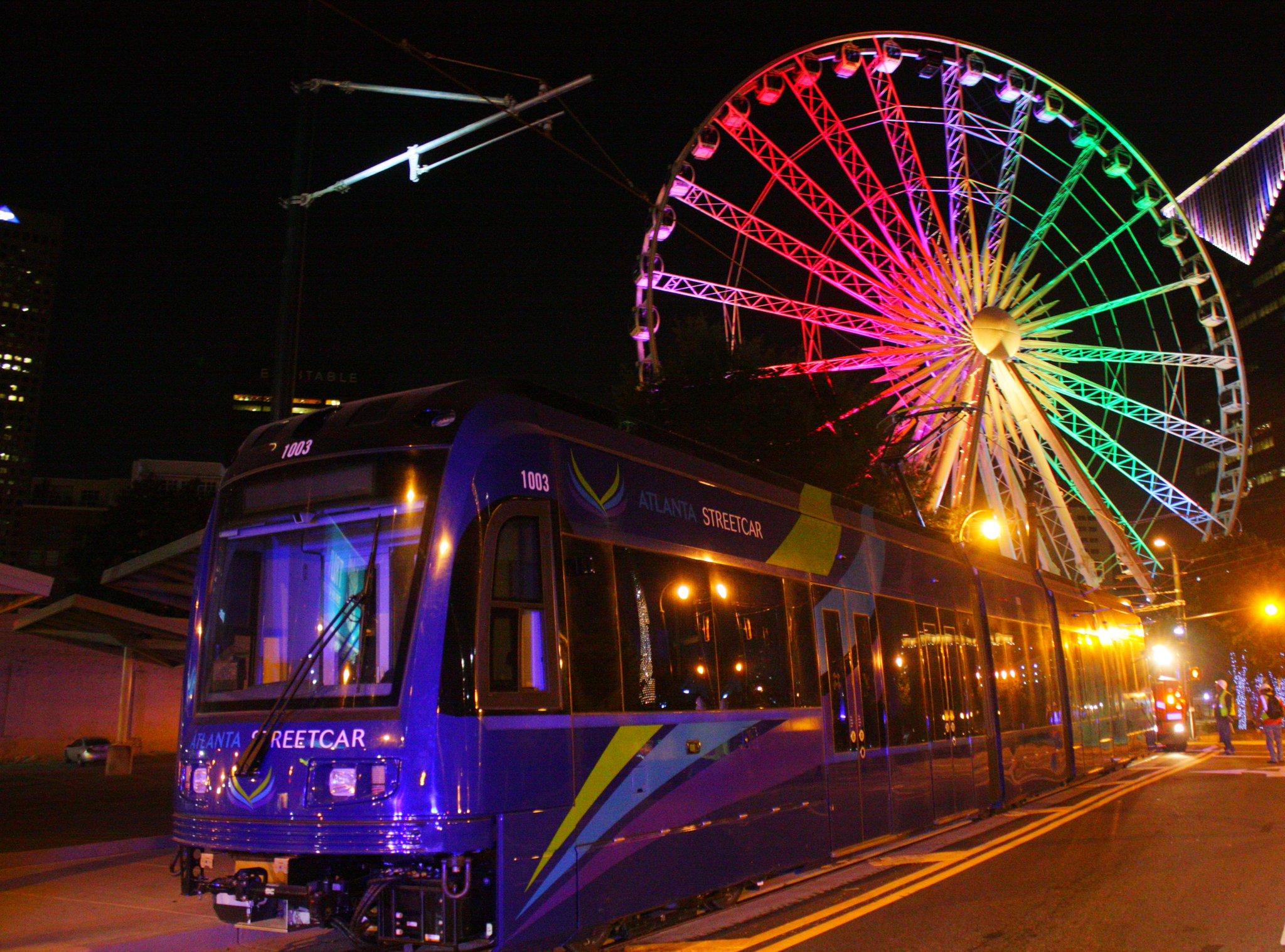
Atlanta Streetcar in the Streets at Night (Testing Phase)
Old Atlanta Streetcars in Demolition Yard: Soon to be Back in Service!

Unsurprisingly, the Atlanta Streetcar's official opening to the public has been delayed once again. This Saturday, December 6th, was suppose to be opening day for the public just in time for the SEC Championship, but according to the AJC, issues and delays with the federal government has once again delayed the eagerly anticipated streetcar. This comes after the reports that the streetcar was suppose to open in November (by the latest), then in fall (sometime), then in the June, then in the late spring of 2014. Now, the city government is promising that the streetcar would be open by December 31, 2014 by the latest... sounds like another broken promise to me?

Whoever is in charge of the Atlanta Streetcar (Atlanta City government and MARTA apparently) has been doing in my honest opinion a horrendous job in the designing, construction, communication, and planning behind the new transit system. Problems have plagued the streetcar from its beginning. After receiving a $1 million TIGER grant from the federal government, the running of this agency has been disappointing to say the least. 

Firstly, the design of the 2.7 mile stretch around Downtown Atlanta seems illogical. Recently, Darin, the ATL Urbanist, pointed out some major flaws in the streetcar's route. At one end of the route, the streetcar turns around in the heavily trafficked Farlie-Poplar/Centennial Olympic Park area. During Falcons games and other major events downtown, the streets, parking garages, and surface lots are full of cars parked or finding parking for their respective event. The streets are packed, and the logistics of moving a 200-ton streetcar through these streets seem to have been forgotten. On the other end of the route, the streetcar turns around near an exit to the downtown connector. This means cars here will be mostly outflow traffic and that speeds here will be higher due to the need to speed up to drive on the highway. With slower moving streetcars and increased pedestrian movement moving, this area can become a real hazard for both drivers and pedestrians.       

Secondly, while it is true the streetcar's construction is complete, the construction process was long, slow, delayed, and sometimes detrimental to local businesses. Here, the agency did an excellent job keeping residents, business owners, and invested interests up-to-date with construction movement, it still did not make up for the fact the its construction was delayed. Last year's snow were partially a problem, but the streetcar agency themselves stated that the weather only caused about a two-week delay. Hopefully when the streetcar expands to the Beltline and North Avenue in the future, construction will be more organized, systematic, and efficient. 

In addition, the Atlanta Streetcar Organization's communication and planning with the public has been less than stellar. In a city, where residents are truly interested and invested in their communities, the organization has done little to engage and interact with the community. While their Streetcar Socials have been a hit, communication between the organization and residents has been inadequate. For instance on their website, their FAQ section says, "Updated as of October 2014." With the approach of the grand opening, the agency should be open and public for questions from the community and region, but instead they are acting like the FBI only releasing certain facts in their press releases which has done privately through the AJC or local news organization. In the future, the Atlanta Streetcar should be more open and forthcoming in agency developments and progress instead of secretive and not informing (may I remind everyone of the surprise testing period they announced last May).

And while the Atlanta Streetcar has had more than its fair share of problems that I am not afraid to rant and comment about it, I believe it is still integral to our city's future. It will connect all the major tourist centers, parks, office areas, and GSU in Downtown Atlanta. Its small 2.7mile route reconnect Atlanta's Central Business District with the Sweet Auburn and MLK neighborhoods which the city has promised to do since the building of the downtown connector. Also, this 2.7 mile loop will the serve as the base for a greater network of streetcar routes the city hopes to add to its infrastructure. It symbolizes both the progress of the future and the inefficiency and issues of the past. So I can't wait to ride the Atlanta Streetcar before December 31, 2014.