Tuesday, May 26, 2015

What Seattle and Gwinnett Have In Common? Voting No, Apparently

Seattle Traffic
Today, I read an article in the Seattle Times about a decision their citizens made in the 1970's. The journalists wrote about how a referendum that would subsidize heavy rail by the federal government failed due to lack of support by the people of Seattle. He then compared Seattle's decision to Atlanta's decision in which we DID support the same referendum. The result was Atlanta was given millions of federal dollars to design, implement, and run MARTA. About 50 miles of heavy rail line was laid out throughout the city, connecting major business hubs with the CBD and the airport. Seattle on the other hand was forced to let sprawl become king in King County because its citizen choose to not invest in long term mass transportation options. In 2015, both Seattle and Atlanta have suffered from the effects of urban sprawl with long commute times, smog, and few alternatives to using a car. The difference, according to the journalist, is that in Atlanta we have the option to use an efficient and well laid out subway/heavy rail system when in Seattle, they are confined to their less efficient, slower light rail and commuter rail system (this of course is very debatable but he's not from Atlanta, so we can't blame him).

Looking across Metro Atlanta today, you can see a changing opinion of what the region needs in terms of transportation needs. Within the Atlanta city limits, the people are all gung-ho for more transit where there is strong support the expansion of the Atlanta Streetcar and the Atlanta Beltline. In DeKalb County, residents support a light rail line through the Clifton Corridor connecting Lenox with Avondale MARTA stations. In North Fulton and Alpharetta, residents are starting to come around to the idea of using MARTA to enhance the Connect 400 Initiative. In Clayton County, residents saw MARTA bus service begin limited service to parts of the county, after they voted yes on a referendum asking whether the county wanted to join the system. Even in Cobb County, county commissioners will vote on a budget tonight that earmarks money for a referendum on a bus rapid transit line. (YES, you heard me right, Cobb County!) And in Gwinnett, their Chamber of Commerce conducted a survey on whether residents would support expanding MARTA to the county, and 63% said they would support an expansion. But when the Gwinnett County Commission was asked about an expansion, she says the county needs to have a "comprehensive discussion about transportation in the county" before making any rash decisions (No offense Mrs. Nash, but WTF have you seen our commute times?)
Gwinnett County Municipalities and Main Thoroughfares
As a resident of Gwinnett County, its pretty obvious to me that not only do we need to have a discussion about transportation, but we also need to act on it because rush hour is actually "let's sit on 85 and do nothing" hour in Gwinnett. As a transit enthusiast, I do not understand why the pro-business commissioner is hesitating on supporting transit: expanding mass transit create jobs in several industries, stimulates economic growth, stimulates real estate around transit-oriented developments, provides more access to our businesses, allows for greater tourism with more access to Gwinnett amenities, and is a great investment in the future success of the area. Yes, we would be taking on a large and costly investment, but the benefits are too good to pass on and the alternative would mean stunted economic growth for the county.

And when you look at the county as a whole, there is also greater reason to question the commissioner's hesitancy. Gwinnett is the second largest county in the state with over a half-a-million people living there. It is diversifying faster than any other county in that state and will soon be a majority-minority county. It is a middle class heaven where homes are affordable, the schools are incredible, but the cars and transportation costs are expensive (even with the low price of gas currently). While the Great Recession really hurt the local economy, strong leadership by our commissioners and county government prevented our budget from going awry and unlike other counties, Gwinnett fared better with less layoffs and budget cuts during the recession. To me, Gwinnett's current demographics and stable budget are all the more reason, we should be like Atlanta and be gung-ho for making a major investment in mass transportation.
What Bus Rapid Transit or Light Rail Transit could look like on Satellite Boulevard
But one difference between Chairman Nash and me is where we live. She lives in the less populated eastern side of the county where its more rural than urban. I live in the middle of the I-85 corridor where the demographic shifts, worse traffic, and increased densification is more obvious and has had a greater impact on the quality of life. This means that throughout the county different areas have very different wants and needs. My neighbors and I need access to a BRT or LRT line that can ease the flow of traffic on I-85 and provide more commute option between our neighborhoods and the major business hubs. But residents of Dacula and Grayson have no interest in using or more importantly paying for a transit line along the I-85 corridor when they live and work elsewhere. So when this comprehensive conversation about transportation begins in Gwinnett, I hope this demographic difference is noted.

One way to bridge the gap between the disconnect between the different areas of Gwinnett is to create more Community Improvement Districts along the I-85 Corridor and elsewhere. CID's would allow citizens in Unincorporated Gwinnett to have more of a voice of what goes on in their communities. It would also allow citizens to address their most immediate needs in their respective regions. Around the Gwinnett Arena, a CID would focus on smart growth, transportation needs, and traffic easement while other CID might focus more on safety or environmental needs.
Jimmy Carter Boulevard Diverging Diamond Bridge Rendering
Already in Gwinnett, the Gwinnett Village and Gwinnett Place Community Improvement Districts have  already made huge impacts on their respective communities and have partnered together to outline the need for a light rail line on Satellite Boulevard. Their work has created diverging diamonds on the Jimmy Carter Boulevard and Pleasant Hill Road bridges and has beautified and cleaned up the public spaces and sidewalks. Without their CID titles none of this work would've been done, and they do not create the expensive bureaucracies that municipalities such as Norcross or Lawrenceville need.

In addition to using the CID's for more localized issues, in about two-three years time when the county government will be ready to present and allow residents to vote on a transportation referendum, allowing CID's to vote on the referendum as units would better help the county. For instance, CID's along I-85 could vote "Yes" and receive the much needed public transportation investments they desire, while other parts of the county could choose to vote "No" and spend their taxpayer money elsewhere without impacting the needs of another part of the county.

My idea may be a little too extravagant and complicated, but the point is that in Gwinnett, one size does not fit all. So when the Gwinnett Chamber of Commerce and the county leaders take the initiative to make transportation a priority, I hope we can make a real impact on focusing on localized areas rather than the diverse county as a whole.                    

Wednesday, April 15, 2015

Densification Vs Reurbanization (aka OTP vs ITP)

Silicon Valley's Suburban Growth and Densification due to Large Technology Companies
Recently, I read an article about how Silicon Valley in California was losing its suburban identity to a pseudo-urban environment. Located outside San Francisco, Silicon Valley is an edge city that is home to technology companies such as Apple, Google, Oracle, HP, and many others. With the technology boom of this century, these companies are expanding and causing the economy in Silicon Valley to boom. As a result, the low-rise, one-story office complexes that characterized American suburbs are being replaced with medium-rise office buildings that house hundreds of more employees. These buildings add density and more people to Silicon Valley helping greatly boost its economy, but the edge city now lacks the amenities that make it either a comfortable suburb or a vibrant city.

In Atlanta, a similar situation is playing out. Unlike the economy dependent of the technology companies in Silicon Valley, the Atlanta economy is a diverse mixture of large Fortune 500 companies, small businesses, and start-ups. But Atlanta has developed similar to Silicon Valley in that its edge cities are growing and intensifying in density making them less of a suburb and more of a large city. So in this post, I am going to look at some the merits and faults of companies that choose to locate inside-the-perimeter versus companies that choose to locate outside-the-perimeter.
NCR's Current Suburban HQs in Duluth
Recently, NCR announced that it would move its corporate headquarters from suburban Gwinnett to urban Midtown Atlanta. Before NCR was located in Gwinnett, the company was headquartered in Dayton, Ohio. During the early 2000's, Gwinnett government offered NCR enticing tax incentives to move its headquarters to Duluth, Georgia. NCR took up Gwinnett's offer and moved their HQ's to several newly built medium-rise office buildings on Satellite Boulevard in addition to some older one-story office buildings there as well. This move brought over 3,000 jobs to the area helping fuel the housing market boom and the expanding service economy. The low costs plus the benefits of Gwinnett's excellent schools and suburban climate made the move an overall smart move.

But when the tax incentives began to dry up after the recession, the technology company began to consider moving its headquarters away from its suburban home to a more dense and central location. Reportedly, NCR executives looked at several locations across metro Atlanta including Alpharetta, Dunwoody, and Sandy Springs but ultimately decided to move to Midtown at Tech Square (with a large cash incentive awaiting them there). NCR plans to develop a high-rise for its headquarters and hopes to benefit from the start-up community and Georgia Tech students located around Tech Square. So comparing this move to their Gwinnett move: NCR will be paying for land at a premium, they will have to pay the city of Atlanta's higher taxes, the cost of living is more expensive, and workers will have to consider either commuting in from the suburbs where they currently live or moving intown where the climate is not always best suited for family living. On the other hand, the company will receive a handsome cash incentive from the city of Atlanta to help with the transition (upwards of several millions), they will be located near top-tier talent around Georgia Tech, they will located within a city with a vibrant culture and have access to public transportation (instead of being stuck in suburban traffic), they will own a piece of Atlanta's notable skyline and their signage will be seen by every driver on the connector, and they can provide a better work climate for their employees in the city.  

NCR's plan to move to an urban location or its "reurbanization" signifies a shift in companies and businesses who are now focused on creating an excellent work environment with access to the most qualified workers instead of attaining the lowest costs. And as a result, edge cities are changing their growth patterns to adjust themselves to this corporate shift. For instance, Alpharetta is no longer focused on building the most homes or the best malls. Instead, Alpharetta is investing into drive-to urban destinations such as newly developed Avalon or its developing new town center. These mixed-use developments are home to luxury condos and apartments, street level shopping, small parks, and office-space in the buildings upper levels. Around these mixed-use developments, the new commercial and residential developments are focused on walkability and access to these new "urban" amenities instead of the strip malls or cul-de-sac neighborhoods that typify suburbs. Also, Alpharetta is expanding in the education sector with the building of a Gwinnett Tech satellite campus. In addition, Alpharetta focuses all new development towards completing its city master plan that guides the planning department towards the best land development of the city. All of this means that instead of being the home to Fortune 500 office parks, malls, strip malls, and gated neighborhoods, Alpharetta wants to be the home to a more dense and less suburban edge city.  
Avalon in Alpharetta
Alpharetta's "densification" is a shift from its suburban origins and as a result, Mercedes Benz is relocating its North American headquarters there from its current suburban location in New Jersey. Mercedes Benz cites cash incentives, a need for new talent, and the economic climate in Atlanta and Alpharetta as reasons for its move. So now, Mercedes Benz has bought land in Alpharetta for a premium (due to Alpharetta's location and densification), plans on building an urban-like, mixed-use campus to foster a better workplace community, have a high-rise building that provides signage to GA-400, and have access to Atlanta's finest workers. Sound similar to NCR's move to Midtown? It should because both companies are moving to their new locations for the same reasons. The only difference is the location: downtown vs edge city.
Avalon Phase II   No Logo[12]
Future Plans for Alpharetta's Avalon Development
So is the current suburban densification any different from the urban revival taking hold of Atlanta. In many ways no: mixed-use developments, high prices, good locations, and the appeal of its workers or residents characterizes both the metro Atlanta's densification and the reurbanization in the perimeter. But there are differences in that the edge cities still lack the culture, public transportation access, or density that the city of Atlanta has while the city lacks the good schools, the safety, and affordable amenities that edge cities are home too.        

Friday, February 20, 2015

Creating People Places

 Portion of Atlanta's Skyline
Recently in the Saporta Report, the President of AIA Atlanta called upon Atlantans to begin investing in significant and meaningful architecture rather than just covering the basics. She wants Atlanta to be home to some of America's most architecturally significant structures in the next decade. She refers us to observe Dallas which in the last ten years has built some of America's most important buildings. The beautiful architecture in Dallas adds to the city's character and vitality making Dallas a more attractive and thus livelier city. Atlanta already has its own strong character and independent identity. The people of Atlanta fill the city with a quiet vibrancy and buzz that is unique to the Big Apple of the South, but when it comes to our significant architecture, we are somewhat lacking.

It's true that our skyline is a stunning sight and buildings like the High Museum and Fox Theatre are beautiful, but other than that our buildings are lacking when compared to other American cities. Even along Peachtree Street, refurbished strip malls line some of our most important intown districts. While paint can do an old building wonders, its not necessarily the most aesthetically pleasing piece of architecture our city can offer. And recently, Curbed Atlanta highlighted some of the city's new high rises in the pipeline. They showed a comparison between two apartment buildings being built in Buckhead and Midtown, and both buildings looked remarkably similar. While still nice buildings, this is not the kind of stunning new architecture that will set us apart. 
The High Museum
When looking at the High Museum, the entire focus of the building seems to be on its purpose, a world-class art museum. People are given an incredible experience of beautiful art, and the museum integrates its architecture perfectly into that purpose. Instead of getting carried away with the minute details the building maintains its focus on art and your experience with art throughout it. While seeing the world's finest compositions and exhibits, you can see how the skylights in the ceiling, the open concept, the spiral staircase, and glass windows all add to the art. But in the High, you won't find yourself complaining about getting lost, weird layouts, or an awkwardly placed atrium because the focus of the architecture isn't distracted on the building itself, but zoned in on the art and your interaction with it.

By making new buildings and structures in Atlanta focus on its purpose with the people who will use it rather than the many other details about the building, Atlanta will find more architecturally significant buildings being built. For instance, instead of becoming distracted by all of the different components that can take away from a buildings purpose, maintaining a constant focus on its use will make the building more appealing. Then, you can begin to add in the other details that make buildings like the High Museum stand out. Its purpose is clear and the architecture around it adds to that purpose rather than taking away from the art. 

As an example, if the city was replacing an old library with a new state-of-the-art library, by focusing on its main components: its books, computers, and quiet areas, the city can create a building people will find useful. Then, the architects can focus on adding details that further add to people's experience. Large windows that let in Atlanta's sunlight, an open concept centered around a central meeting space with different nodes expanding out from this space, and indoor floor-to-ceiling windows that let people see other parts of the library would make this a place not only useful to Atlanta citizens but also a place that they would want to be and stay in. 
Dallas Architecture
So Atlanta can try and take after Dallas and become a model city for stunning architecture, or we can take our own path by focusing on the people that already make this city great. By focusing on the people's needs, architects can then design places that Atlantans would want to live, work, and play in. Significant and expensive architecture will add to Atlanta's vibrancy, but I believe our architecture will be the most successful by also focusing on the people. Atlanta needs to create people places.   

Sunday, January 25, 2015

Why We Can't Afford Inaction Anymore

Spaghetti Junction in Gwinnett County- this year's legislative focus: transportation and infrastructure
This month the General Assembly opened up its 2015 legislative session. Top issues this session range from continued prison reform led by Governor Deal to controversial educational reform about state-control over failing school systems. But, the issue that will take up the majority of the attention this session is over transportation funding. Last year, a legislative task force on transportation funding released their recommendations that told us something we already knew: Georgia needs to reinvest itself in its transportation system and quickly.

Their study found that we need to raise $1-1.5 billion in revenue for infrastructure improvements and repairs. With the facts now laid out on the table, its time for our representatives to act on this issue because if we don't, not only will we not have alternative transportation options, but we won't even have adequate roads for our car-centric region. We might be the number one state to do business in currently, but in the near future, we won't be if we are stuck in traffic on failing roads and bridges that are falling apart beneath our tires. To me, the regular citizen, the answer seems obvious: raise taxes for transportation so we can move on to life's more pressing issues.
Governor Deal hopes for action on transportation funding this year in the Georgia Assembly
Unfortunately though, there is a current faction within the Republican party known as the Tea Party whose mission seems to be never raising taxes EVER. This is unfortunate since we still need $1-1.5 billions worth of transportation improvements and repairs for our roads and transportation systems, and we have no other source of funding for this except through raising taxes. Governor Deal, Casey Cagle, David Ralston, and many other republicans understand and agree that something has to be done, and currently, they believe the best way to raise these funds is through a gas tax. But with about half  of the Republican party out the picture in supporting this tax, Republican State Senate and House leaders will have to reach out to the other side of the aisle to pass this bill. Democrats in Georgia generally support investments in infrastructure, but they will probably only support this tax if some small portion of it goes toward an alternative transportation fund. This means there will be a lot of debating, bickering, and hopefully compromise in the 2015 legislative session.

But all of this is expected in a Red State such as Georgia. What is unexpected and gives this tax an actual chance (unlike T-SPLOST 2012) is that the economy in Metro Atlanta and Georgia is booming like it was before the Great Recession, gas prices are lower than they have been in years due to the introduction of more American-produced oil in our market, and MARTA's new leadership and improvements are improving the region's image of public and alternative transit in Atlanta. Firstly, a strong economy provides consumers' confidence at home meaning that traditionally conservative households this year will be more open to allowing their representatives to vote yes to an indirect tax increase. Furthermore, with gas prices being so low, people will be more open  to the idea of a gas tax since they can actually afford paying a gas tax currently. Also, MARTA had a stellar year last year, and as a result, government officials have more confidence and trust in the agency and its ability to function as a viable alternative to driving within the region. So the strong economy, low gas prices, and high opinion of MARTA can provide the recipe for success for a gas tax to raise transportation funding, but what cannot happen is doing nothing like in times past.

If we do not act on transportation funding during this legislative session, our governmental officials are putting our region's future at the risk. If they care about not only our reputation as an international city to do business and work, but also, the sustainability and livability of the residents living in Metro Atlanta and the state of Georgia, they will find a way to pass this gas tax. We cannot allow inaction anymore because it is not a solution when we have over $1 billions worth of infrastructure repair and improvements needed. The federal government will not come to our rescue, private investment will not come to our rescue, only the representatives in the Georgia Assembly this legislative session can provide for this region and state's future. So it is time to act up and make some actual progress this year.

"We can debate how much it costs to do something, but let us not forget how much it will cost to do nothing." -Governor Deal at the start of the legislative session this year 

Sunday, December 21, 2014

It's Time To Cut The Commute

Atlanta Railroads in the early 1900's
Atlanta was built on rails. If you ever travel downtown, you might notice the cities complicated street grid. Unlike most major U.S. city street grids which run North-South like in New York or Philadephia, if you look at Atlanta's old CBD, you will find that it sits sideways on the street grid. This is because when the city was first built, it was built up around the connection of several train lines. So the adjacent development mirrored the diagonal nature of those railroads. The railroads then continued out from the heart of what is now "underground" Atlanta and moved outward in all major directions. The railroads basically sprawled out in each direction from Atlanta.
Atlanta Interstate in the 1970's Just South of Downtown
In the 1960's, another road was then built from the heart of Atlanta and has also sprawled out from its core. The interstate bulldozed its way right through the center of our city, and from the interstate, suburban development has enveloped the city of Atlanta. Suburbs sprang up as if from nowhere, and these new smaller, closer communities became and still are an enticing reason to move to Atlanta. But with population growth comes more congestion, and so now the small towns like Lawrenceville, Roswell, Conyers, Kennesaw, and Douglasville are mini metropolises of traffic and car mayhem. 

So what's the connection between the old railroads and the lifeline of our city, the interstate? The answer lies in the maps. Along every major interstate and highway in Atlanta, a railroad runs parallel with it. Coincidence? I think not! The highway developers of the 60's and 70's purposefully built the interstate right next to the rail and rail towns already built. It was the best way to provide a route in and out of Atlanta in connection with the other nearest cities. So as the rails that built Atlanta began losing its prestige and importance, the interstates took its centerpiece place. The novelty of driving your own car wherever you needed it became the defining characteristic of new Atlanta development. Walk-ability and smart development took the bench while new roads and single family homes became the new norm. The integral part of this system was the road that connected them all: the interstate. The interstate was our new rail, our new connection between work and home.

But today at the end of 2014 this driving novelty has worn off. With 4.5 million people living within the 10 county metro region and an expected 2.5 million more people to come by 2040, we have found out that our transportation system isn't flawless. Traffic backups are now a defining characteristic of life in Atlanta. Everyone complains about it, everyone hates it, and everyone has been stuck in it, but what has anyone done about it? Absolutely nothing! When the housing boom of the 1990's and early 2000's took hold of the city, our government officials did no planning to prevent the congestion that continued to grow everyday. Their mentality was to build, build, build, and people bought into the new, newer, and newest communities they were building. But never did they offer the suburbanites an alternative to driving. The new developments came along with a garage and a driveway because automobiles are the only way to successfully get around Metro Atlanta now-a-days. So it is not surprising that a 30 minute commute takes over two hours during rush hour. It's just the "norm" or a part of life in suburban Atlanta.

But this norm isn't attractive. When Northerners consider moving their homes and business south to Atlanta, they love everything about our lifestyle except the lack of transportation options. They want to take the subway, the commute train, or the bus because they know how efficient and easy public transportation can be, and they (like any normal person) despise traffic. It is not appealing to millennials looking to start their small business or family, it is not appealing to the elderly who want to retire in peace, and it is not appealing to white-collared workers because it takes away from their free time. Traffic has become one of the main deterrents to moving and living in Atlanta. So if Atlanta wants to continue to grow and expand, we can no longer ignore this traffic problem.

If you are asking, what are metro leaders doing now to help alleviate this problem, there is some good news. Suburban cities such as Suwanee, Woodstock, and Marietta are developing their communities into live, work, play communities where ideally you can have a home, go to work, and have a nice lifestyle in the town centers they have developed. All new development in these cities are now directed at this more sustainable and smarter growth pattern. The success these cities have had with this concept is now being transplanted in more suburban communities across the metro, but this has done little to help the Cobb or Gwinnett commuter who depends on the interstate daily to get to work and back. Interstate-dependent Counties and GDOT leaders have pushed for expanded HOT lanes (toll lanes) outside of the Perimeter. On these HOT lanes, GDOT can move commute buses back and forth from major work hubs and residential hubs, but the lack of advertisement, the lack of bus stations, the complicated system maps, and the interstate traffic they can't avoid have made these commute buses less successful.

But instead of blaming government officials for our traffic woes, its time to take some of the blame ourselves. Suburban counties could have MARTA service, but instead residents have voted down joining the system every time (except for now Clayton County). In 2012, when we could have provided city planners extra funds to fix our transportation system, the Metro area voted no to TSPLOST. Every time the government has offered an alternative to traffic and the interstate, Metro Atlanta has said no. So while we can complain and groan about the traffic and the smog and the waste of time, we also have to take responsibility for the predicament we are currently in.
Salt Lake City Commuter Rail (a system Atlanta can model itself after)
A solution to the congestion, I believe, lies in our past. Along every major suburban corridor in Atlanta, an old but still important freight railroad runs through each corridor. The same rails that I mentioned at the start of this post that first brought business and prosperity to Atlanta can once again do the same. Adding commuter trains and train service to suburban communities on these railroads will help alleviate traffic congestion from the interstate. Both the interstate and the railroad runs through or near major Atlanta work hubs such as Buckhead, Midtown, Downtown, and the airport, so providing Atlantans an alternative to the highway with the final destination being the same will draw thousands off the highway and onto commuter trains. Also, the commuter trains will be able to connect Atlantans to all the other major urban corridors throughout the city. For instance, the same railroad that travels through Carrrolton, GA also runs through Athens, GA. Providing Metro Atlantans with this kind of connectivity in public transportation for a low cost will increase business and help build a strong economy dependent of gas prices and cars. The benefits outweigh any drawbacks from providing commuter rail service to Metro Atlanta.

This being it's time to cut the commute. Commuter trains can provide direct transportation access to all of Atlanta's major centers on both sides of the Perimeter, its rail corridors are located in Atlanta's most densely populated areas and are located near millions of residents, and its service can cut commute times in half by offering an alternative to the automobile, the interstate, and the traffic. We can no longer afford to depend entirely on one transportation mode. By establishing a private-public partnership with county governments and and the business community called "Friends of the Commuter Train," the government can gain support for bringing commuter rail to entire metro, but in the end, the only way we can bring an alternative to the interstate is through the community. If Atlantans, the everyday people, demand an alternative, someone will provide. Whether this happens through a government-owned transportation system or through a private company, it doesn't matter, but if Atlantans demand for commuter rail, we will receive. We own this city in addition to its destiny, so it is up to us to call for more action, more options, and more change to the urban metropolis we call home. It's time to cut the commute, and we can do this through our past: through trains.  

Friday, December 5, 2014

Making Downtown Small Town

Recently, CNN published an article on "6 Reasons To Love Atlanta." In this article, they had a section describing Atlanta as a "city of small towns," and then, they detailed some of our city's most special and unique neighborhoods. In this section, they also pointed out another blatant fact: the lack of strong community and belonging in Downtown Atlanta. While our downtown lacks the heavy density and boisterousness of other Central Business Districts across North America, underneath its tired facade, a small town from another time still exists. I believe Central Atlanta Progress can recapture the spirit that built and created the big city of Atlanta through building on a new kind of concept: the one that Downtown is a small town.
Broad Street in Downtown Atlanta
When you look across our entire metro, you will find small towns and little municipalities splattered across the ten counties that make up our region. And it doesn't matter if you live in an edge city such as Woodstock or in the urban core like in Midtown, each city and neighborhood shares a strong community bond and tight culture that is characteristic of the small towns CNN refers to except at the heart of the region in Downtown. Downtown does have a community and culture, but not one that is going to attract others to come live, work, and play there. But luckily, this is something that can be fixed by city planners and developers, and something that will instigate innovation from the people who chose to inhabit Downtown.
 
A Fairlie-Poplar Street Ripe for Redevelopment

So, one way to build a small town feel in Downtown is to create the "small town" which is actually easy since one already exists! The Fairlie-Poplar neighborhood houses Atlanta's old CBD and is registered as a National Register Historic District. Its quaint tree-lined streets and architecturally-significant buildings serve as a hidden treasure underneath the towering skyscrapers that surrounds the neighborhood. The neighborhood has been partially redeveloped on the east side where there are a few Georgia State academic buildings, housing, and the redeveloped Broad Street. But on the west side, Fairlie-Poplar remains a relative dormant district with parking garages taking the place of what could be office space, residential buildings, shops, and restaurants. The city can make this neighborhood an Atlanta hot spot for both millennials and families by firstly making it more friendly to people. By closing off some small streets and alleys to cars, and making them only accessible to pedestrians, bikers, and streetcars, the city can create a sense of shared place. Also, by opening up and creating more street front property, the city can attract both small businesses looking for a trendy place to set up shop as well as big-name businesses interested in getting a share of the economic booms from redeveloped urban cores. Finally, by redeveloping the parking garages and surface lots of West Fairlie-Poplar into new businesses and homes, the city can reconnect the Luckie-Marietta district home to the award-winning Centennial Olympic Park with the rest of Downtown through what would be the newly-bustling Fairlie-Poplar district.
Georgia State in Downtown

Another way Central Atlanta Progress can build up Downtown is by creating a university town. Recently, Georgia State has been quickly buying up and redeveloping a lot of land in Downtown Atlanta. Under the direction of President Mark Becker, Georgia State is determined to create a more residential university-like campus. But due to its location next to Atlanta's CBD, this is a hard task to accomplish for GSU. For city government, the benefits of having a large university at the hands of its biggest employers would be abundant. The city could reoccupy all of its Downtown skyscrapers with businesses interested in benefiting from young, educated, cheaper employees. Georgia State would attract more students interested in getting work-place experience with so many top-tier companies right at its door step, and the city would benefit because more people and more businesses means more tax revenue and less vacant lots. Partnering with Georgia State to create what would be the first-ever American university town in a downtown will help rebuild Downtown by setting a fuse to the area with creativity, innovation, education, and business.

Also, by looking and following the example of their partner to the north, Downtown can become the center they desire to be. Redeveloping its parks, adding green space, adding more streetfronts, extending sidewalks, and making the area have a sense of togetherness and place, Midtown has been able to create itself as a hip place for people to move and live in. Whether in Atlantic Station, Crescent Street, or Piedmont Park, Midtown has created itself into a place people want to be. Its re-creation and hip lifestyle has made Midtown the small town 20-somethings move to in order to escape the suburbs they grew up in. Downtown can do the same by investing in its image and its actual streets.
Downtown Atlanta: Ready for a Facelift for the People? 

Finally, I believe Central Atlanta Progress can reinvigorate Downtown as a small town with culture, activity, and life by doing something rare now-a-days: by going to the people. Atlantans know what they want. People are willing to drive over an hour to be in the places they like. (For instance, I have suburban friends who now choose to drive 40 minutes to go Atlantic Station to shop and hang out over the Mall of Georgia every time!) By going public and letting the people remodel the city they call home, Atlanta city government has a sure-fire way to build the ideal community. Its time to let us in, and let Atlantans choose what they want instead of trying to build what you think we want! By letting the citizens reclaim Downtown, Downtown will become the best small town of all. It will become the citizens' treasured small town in the city of small towns.

Wednesday, December 3, 2014

Streetcar Breaking News: There Is None


System Map with connections at MARTA Peachtree Center Station
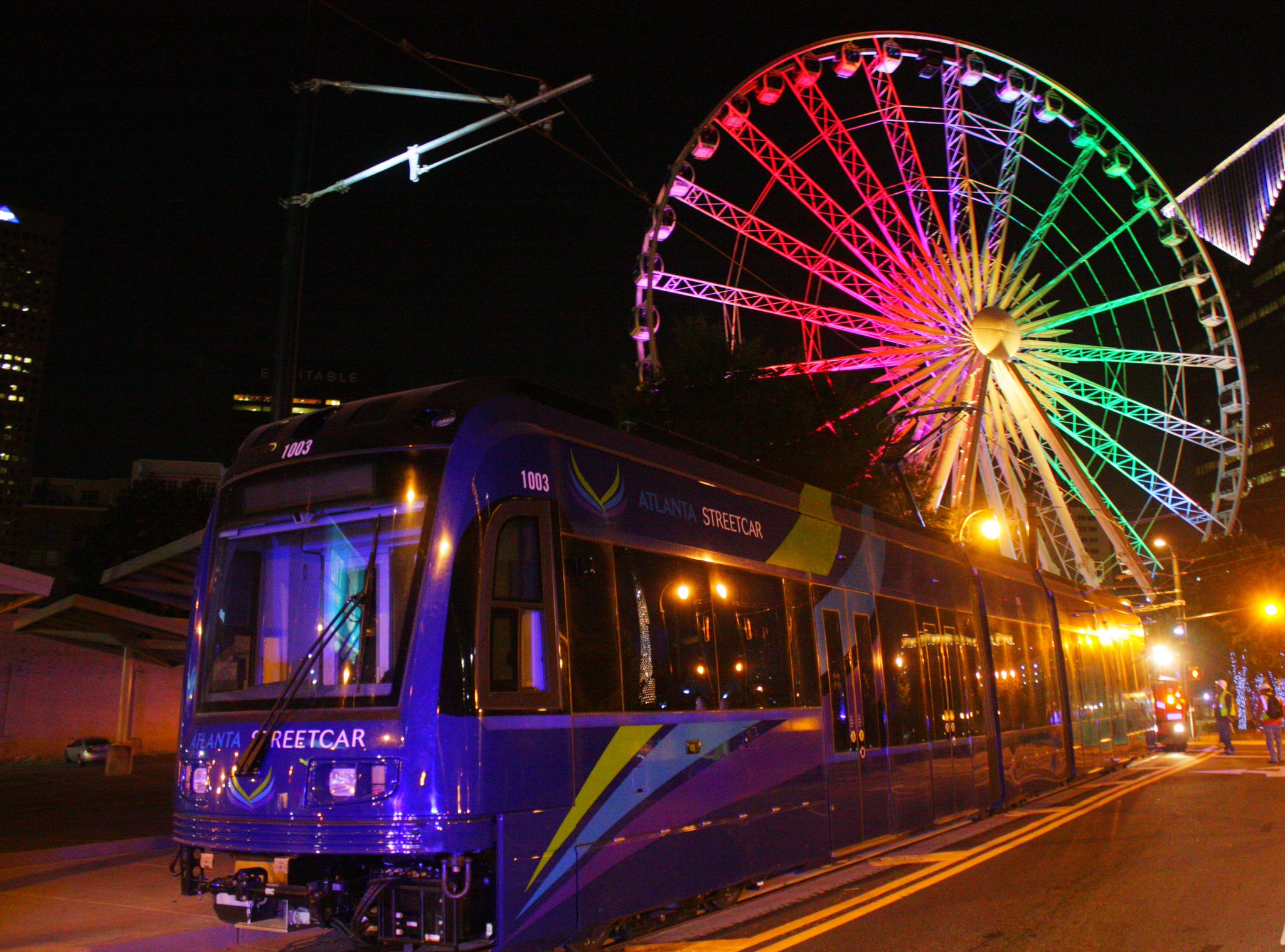
Atlanta Streetcar in the Streets at Night (Testing Phase)
Old Atlanta Streetcars in Demolition Yard: Soon to be Back in Service!

Unsurprisingly, the Atlanta Streetcar's official opening to the public has been delayed once again. This Saturday, December 6th, was suppose to be opening day for the public just in time for the SEC Championship, but according to the AJC, issues and delays with the federal government has once again delayed the eagerly anticipated streetcar. This comes after the reports that the streetcar was suppose to open in November (by the latest), then in fall (sometime), then in the June, then in the late spring of 2014. Now, the city government is promising that the streetcar would be open by December 31, 2014 by the latest... sounds like another broken promise to me?

Whoever is in charge of the Atlanta Streetcar (Atlanta City government and MARTA apparently) has been doing in my honest opinion a horrendous job in the designing, construction, communication, and planning behind the new transit system. Problems have plagued the streetcar from its beginning. After receiving a $1 million TIGER grant from the federal government, the running of this agency has been disappointing to say the least. 

Firstly, the design of the 2.7 mile stretch around Downtown Atlanta seems illogical. Recently, Darin, the ATL Urbanist, pointed out some major flaws in the streetcar's route. At one end of the route, the streetcar turns around in the heavily trafficked Farlie-Poplar/Centennial Olympic Park area. During Falcons games and other major events downtown, the streets, parking garages, and surface lots are full of cars parked or finding parking for their respective event. The streets are packed, and the logistics of moving a 200-ton streetcar through these streets seem to have been forgotten. On the other end of the route, the streetcar turns around near an exit to the downtown connector. This means cars here will be mostly outflow traffic and that speeds here will be higher due to the need to speed up to drive on the highway. With slower moving streetcars and increased pedestrian movement moving, this area can become a real hazard for both drivers and pedestrians.       

Secondly, while it is true the streetcar's construction is complete, the construction process was long, slow, delayed, and sometimes detrimental to local businesses. Here, the agency did an excellent job keeping residents, business owners, and invested interests up-to-date with construction movement, it still did not make up for the fact the its construction was delayed. Last year's snow were partially a problem, but the streetcar agency themselves stated that the weather only caused about a two-week delay. Hopefully when the streetcar expands to the Beltline and North Avenue in the future, construction will be more organized, systematic, and efficient. 

In addition, the Atlanta Streetcar Organization's communication and planning with the public has been less than stellar. In a city, where residents are truly interested and invested in their communities, the organization has done little to engage and interact with the community. While their Streetcar Socials have been a hit, communication between the organization and residents has been inadequate. For instance on their website, their FAQ section says, "Updated as of October 2014." With the approach of the grand opening, the agency should be open and public for questions from the community and region, but instead they are acting like the FBI only releasing certain facts in their press releases which has done privately through the AJC or local news organization. In the future, the Atlanta Streetcar should be more open and forthcoming in agency developments and progress instead of secretive and not informing (may I remind everyone of the surprise testing period they announced last May).

And while the Atlanta Streetcar has had more than its fair share of problems that I am not afraid to rant and comment about it, I believe it is still integral to our city's future. It will connect all the major tourist centers, parks, office areas, and GSU in Downtown Atlanta. Its small 2.7mile route reconnect Atlanta's Central Business District with the Sweet Auburn and MLK neighborhoods which the city has promised to do since the building of the downtown connector. Also, this 2.7 mile loop will the serve as the base for a greater network of streetcar routes the city hopes to add to its infrastructure. It symbolizes both the progress of the future and the inefficiency and issues of the past. So I can't wait to ride the Atlanta Streetcar before December 31, 2014.